
Hölderlin’s Madness: A Successful Failure
But where danger is, grows / The saving power also.

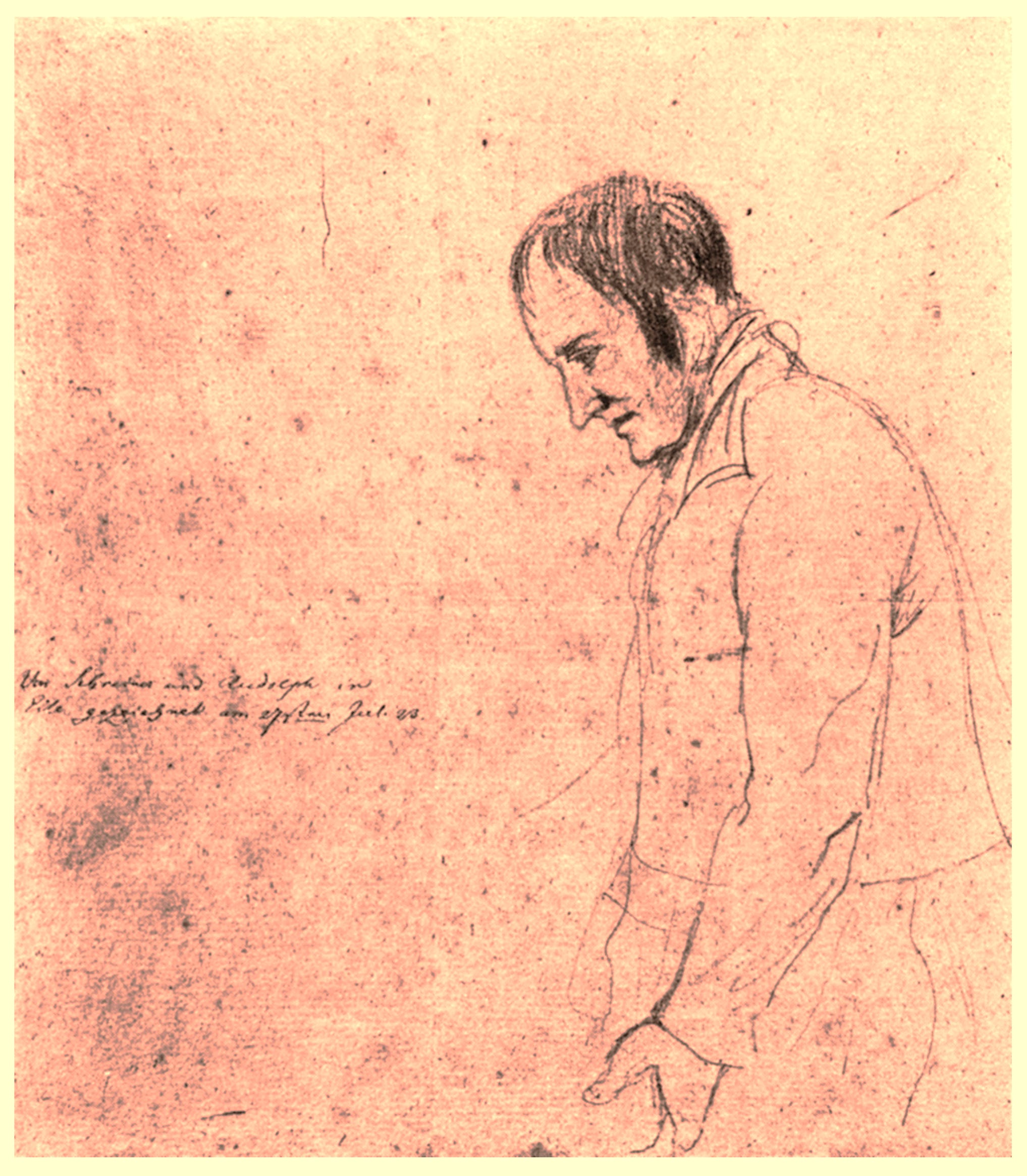
Hölderlin during the “tower period,” based on the drawing by Schreiner and Lohbauer, 1823.
A few years ago my vision blurred to the point that, though blinking, I could not read, and the nerves in my face started burning like tree branches set on fire, tingling, then, in the hours and days after, with strange numb sensations that have never really gone away. In the aftermath of the stroke, under the MRI machine or laying on the grass with my then-one-and-a-half-year-old daughter Avila, I knew—along with terror—a gratitude I’d not yet known (a gratitude to God and numberless others), knew this deprivation was (like many reminders of our utter limits) a difficult gift, and that the time that remains has been given to grow in love and nothing else really. For six months after the stroke I was sure those days were my last. But healing came, and, comically, that urgent, eschatological commitment to increase in love that I’d undertaken with unwavering zeal, faded also.
Dostoevsky gets at this phenomenon in The Idiot, granted the analogy is far from perfect, as his scenario involves a violent firing squad instead of a silent blood clot. Nonetheless, his fundamental point is that the proximity of mortality imparts an eschatological vision. I explore this in a recent piece over at PloughStack, an essay which will appear in altered form in More than a Matter of Taste: The Moral Imagination and the Spirit of Literature (forthcoming in 2026). Prince Myshkin, protagonist of Dostoevsky’s The Idiot, tells of a prisoner who (like Dostoevsky himself) was “led along with others on to a scaffold and had his sentence of death by shooting read out to him,” before, in a matter of minutes, the capital punishment was commuted and replaced by a less severe sentence. But during that awful interval, when the prisoner was absolutely convinced that he would soon die, “it seemed that in those five minutes he could live through so many lives, that there could be no thinking now of that last instant.” The convict, in a passage that parallels Myshkin’s mountaintop epiphany, remembers seeing a church nearby and “staring with awful intensity at that roof and the sunlight lancing from it; he couldn’t drag his eyes away,” as “it occurred to him that those rays were his new state of being.” Given this remarkable, rich perception, the prisoner realized that if he did not have to die, “if life was returned to me—what an eternity it would be! And it would be all mine! I would turn every minute into an age, nothing would be wasted, every minute would be accounted for, nothing would be frittered away.”
Somewhat cynically (but in this case not entirely inaccurately), Alexandra Yepanchina asks whether the friend really did account for every minute afterward. Did he realize his eternity on earth? “Oh no,” Myshkin admits, “I asked him about that; he didn’t live like that at all and wasted an awful lot of minutes.”
Before the stroke I was working on “Hölderlin’s Successful Failure,” an essay that (if imperfect) later came to completion. It’s always been sobering to think these words could have been my last, period.
What would you want your last word(s) to be, what your death sentence?
Near is
And difficult to grasp, the God.
But where danger is, grows
The saving power also.
Read the whole essay via the galley proof here:

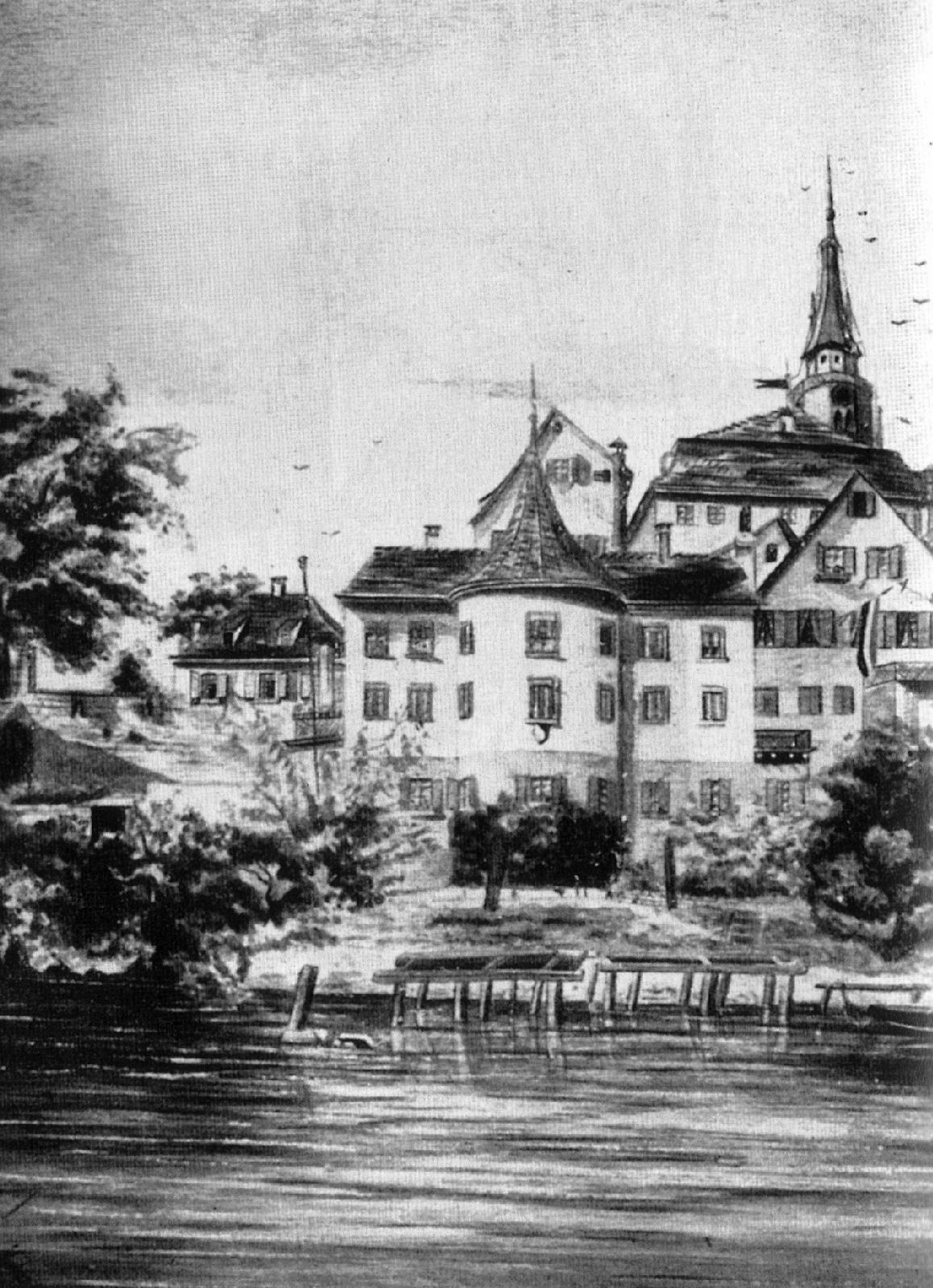
P.S. (The phrase “brain fever” occurs repeatedly throughout Dostoevsky’s novels, and during that difficult time it brought me no small solace to be able to joke about “brain fever” with some wonderful students from my “Dostoevsky and the Eternal Questions” class.)
A reader of mine battling terminal cancer observed how her illness “opens so many insights and clarity of thought.” She also lamented time wasted in the past. Unlike Prince Myshkin, her diagnosis assures no last minute reprieve, but her faith sustains her.
I watched a documentary in which a blind Carthusian monk with “dementia” spoke softly about light and love and God. Josef Pieper may call insanity an innate evil, but for some maybe it’s a kind of divine grace—a portal to higher insight? I thought this upon reading the concluding words of your essay: “But where danger is, grows/The saving power also.”